
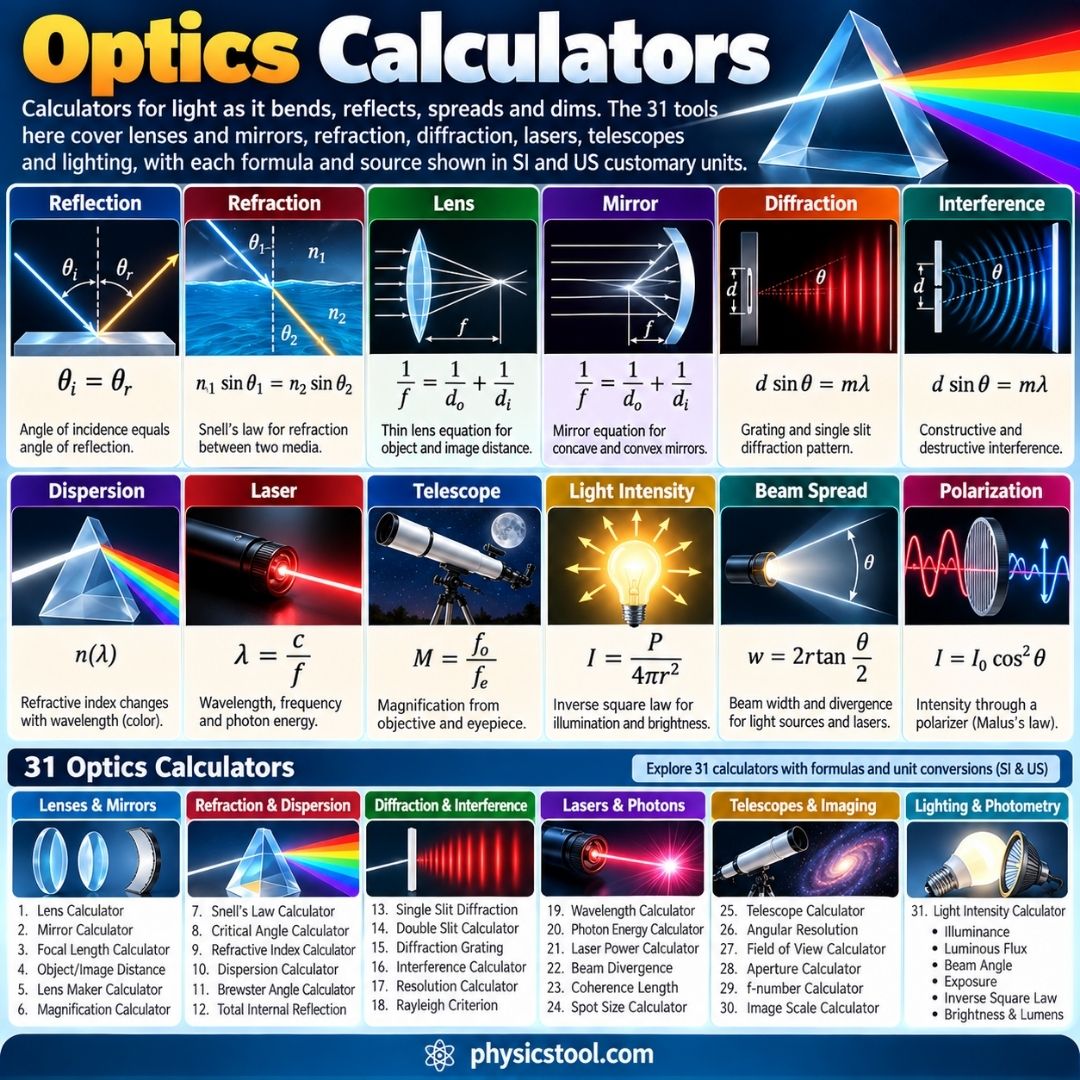
Optics Calculators
Optics calculators for light as it bends, reflects, spreads and dims. The 31 tools here cover lenses and mirrors, refraction, diffraction, lasers, telescopes and lighting, with each formula and source shown in SI and US customary units.
What you can calculate
- Refraction
- Lenses
- Mirrors
- Diffraction
- Polarization
- Lasers
- Telescopes
- Light levels
What Optics Calculators Cover
Optics is the physics of light, and most light problems fall into one of five families. Finding the right family first tells you which formula applies. The optics calculators above are grouped the same way.
| Family | Typical question | Main quantities |
|---|---|---|
| Refraction and polarization | How much does light bend or dim at a surface? | Index of refraction, angle, intensity |
| Lenses, mirrors and eyes | Where does the image form, and how big is it? | Focal length, object and image distance, diopters |
| Wave optics | Where do the bright and dark bands fall? | Wavelength, slit or line spacing, film thickness |
| Lasers and instruments | How wide is the beam, and what can the telescope resolve? | Beam waist, divergence, aperture, magnification |
| Light levels | How bright is the light on a surface? | Lumens, lux, foot-candles, candela |
Every family starts from one fixed number. Light in a vacuum travels at exactly 299,792,458 m/s, and NIST lists it as exact because the meter is defined from it. Light slows down inside glass or water, and that slowdown is what bends it.
Refraction, Lens and Mirror Formulas
The refraction and polarization rows below follow the key equations in OpenStax University Physics Volume 3, chapter 1. The lens and mirror rows follow chapter 2 of the same book. Angles are measured from the normal, the line at a right angle to the surface.
| Quantity | Formula | Notes |
|---|---|---|
| Index of refraction | n = c / v | v is the speed of light in the material. |
| Snell’s law | n1 sin θ1 = n2 sin θ2 | Light bends toward the normal when it slows down. |
| Critical angle | sin θc = n2 / n1 | Only when light goes into a lower index, n1 > n2. |
| Brewster’s angle | tan θB = n2 / n1 | The reflected light is fully polarized. |
| Malus’s law | I = I0 cos2 θ | θ is the angle between the polarizer axes. |
| Thin lens or mirror | 1/f = 1/do + 1/di | Same form for both, with the signs in the next table. |
| Magnification | m = −di / do | Negative m means the image is upside down. |
| Lensmaker’s equation | 1/f = (n − 1)(1/R1 − 1/R2) | Thin lens in air. |
| Spherical mirror | f = R / 2 | R is the radius of curvature. |
| Lens power | P = 1 / f | f in meters gives diopters (D). |
The index values below are the common textbook ones. Water at 1.333 gives a critical angle of 48.6° for light trying to leave it, which is why an underwater view of the surface turns mirror-like at shallow angles. Crown glass at 1.52 has a Brewster angle of 56.7° from air.
| Material | Index of refraction, n |
|---|---|
| Vacuum | 1 (exact) |
| Air at sea level | 1.000293 |
| Water | 1.333 |
| Crown glass | 1.52 |
| Diamond | 2.419 |
Sign Conventions for Lenses and Mirrors
Most wrong answers with optics calculators come from a sign, not from the arithmetic. The thin lens equation works for every lens and mirror, but only if each distance carries the right sign. These follow the convention in the OpenStax chapter linked above.
| Quantity | Positive when | Negative when |
|---|---|---|
| Focal length, f | Converging lens or concave mirror | Diverging lens or convex mirror |
| Image distance, di | Real image (behind a lens, in front of a mirror) | Virtual image (on the object side of a lens, behind a mirror) |
| Magnification, m | Image upright | Image inverted |
Take a converging lens with f = 10 cm and an object 15 cm away. Then 1/di = 1/10 − 1/15, so di = 30 cm and m = −2. The image is real, inverted and twice the size, which is how a projector works.
Move the object to 5 cm, inside the focal length. Now di = −10 cm and m = +2. The image is virtual, upright and enlarged, which is how a magnifying glass works. The negative distance is the correct answer, not an error.
Diffraction and Interference
When light passes through narrow gaps, it behaves as a wave and spreads into bright and dark bands. The same idea links several optics calculators that look unrelated at first, from a CD-like grating to an X-ray crystal and a telescope lens.
| Effect | Formula | Meaning of d |
|---|---|---|
| Diffraction grating | d sin θ = mλ | Spacing between grating lines |
| Bragg’s law | nλ = 2d sin θ | Spacing between crystal planes |
| Rayleigh resolution limit | θ = 1.22 λ / D | D is the aperture diameter |
A grating with 600 lines per mm has d = 1.667 µm. Green laser light at 532 nm leaves its first order at sin−1(0.532 / 1.667) = 18.6°. A 100 mm telescope at 550 nm resolves 1.22 × 550 nm / 0.1 m = 6.7 × 10⁻⁶ rad, about 1.38 arcseconds.
Wavelength, frequency and wave speed are tied by v = fλ. Among the rotational motion calculators, the Wavelength Calculator and the Frequency Calculator handle that conversion for light and any other wave, and the Harmonic Wave Equation Calculator describes the wave itself.
Lumens, Lux and Foot-Candles
The lighting tools among these optics calculators measure light as the eye sees it, not as raw energy. A lumen counts the total visible light from a source. Lux and foot-candles measure how much of it lands on each square meter or square foot of a surface.
| Unit | Measures | Relation |
|---|---|---|
| Lumen (lm) | Total light output of a source | Luminous flux |
| Candela (cd) | Light in one direction | 1 cd = 1 lm per steradian |
| Lux (lx) | Light falling on a surface | 1 lx = 1 lm/m2 |
| Foot-candle (fc) | Light falling on a surface | 1 fc = 1 lm/ft2 = 10.764 lx |
A fixture putting 1,000 lm evenly across 10 m2 gives 100 lx, which is 9.29 fc. The foot-candle factor comes from NIST Special Publication 811. From a point source, illuminance falls with the square of distance, E = I / d2, so doubling the distance cuts the light on a surface to a quarter.
Optics Questions People Ask
These four questions come up again and again in physics classes, eye clinics and on observing nights. Each answer uses the formulas above with real numbers, so you can check the result against the optics calculators in the grid.
Why does a pool look shallower than it is?
Light from the bottom bends away from the normal as it leaves the water. Your eye traces the ray back in a straight line, so the bottom seems higher. Seen from straight above, the apparent depth is the real depth divided by the index of water.
A pool 2 m deep looks about 2 / 1.333 = 1.5 m deep from above. The effect grows at slanted viewing angles. It is also why a straw in a glass looks bent at the water line.
How far away is the horizon?
With no air, the distance to the horizon is √(2Rh), where R is Earth’s radius and h is your eye height. For a 1.7 m eye height and R = 6,371 km, that is about 4.65 km, or 2.9 miles.
Air bends light slightly downward, so you can see a bit farther. Radar and survey work often model this by using four thirds of Earth’s real radius, which stretches the same 1.7 m view to about 5.37 km. Hills and waves then decide what is actually visible.
What does a diopter number on glasses mean?
A diopter is the power of a lens, the inverse of its focal length in meters. A −2.50 D lens for nearsight is diverging, with f = −0.4 m. A +2.00 D reading lens converges with f = 0.5 m.
Glasses sit about 12 mm in front of the eye, while contacts sit on it. That gap matters for strong prescriptions. A −6.00 D glasses lens equals about −6 / (1 + 0.012 × 6) = −5.60 D at the eye, which is why contact lens powers differ from glasses above about ±4 D.
Does a bigger telescope magnify more?
Not by itself. Magnification is the focal length of the telescope divided by the focal length of the eyepiece. A 1,000 mm telescope with a 25 mm eyepiece gives 40×, and swapping to a 10 mm eyepiece gives 100× on the same scope.
Aperture sets two other things. A wider lens or mirror collects more light, so faint objects show up. It also sharpens detail, because the Rayleigh limit shrinks as D grows. Pushing magnification past what the aperture can resolve only makes a blur bigger.