
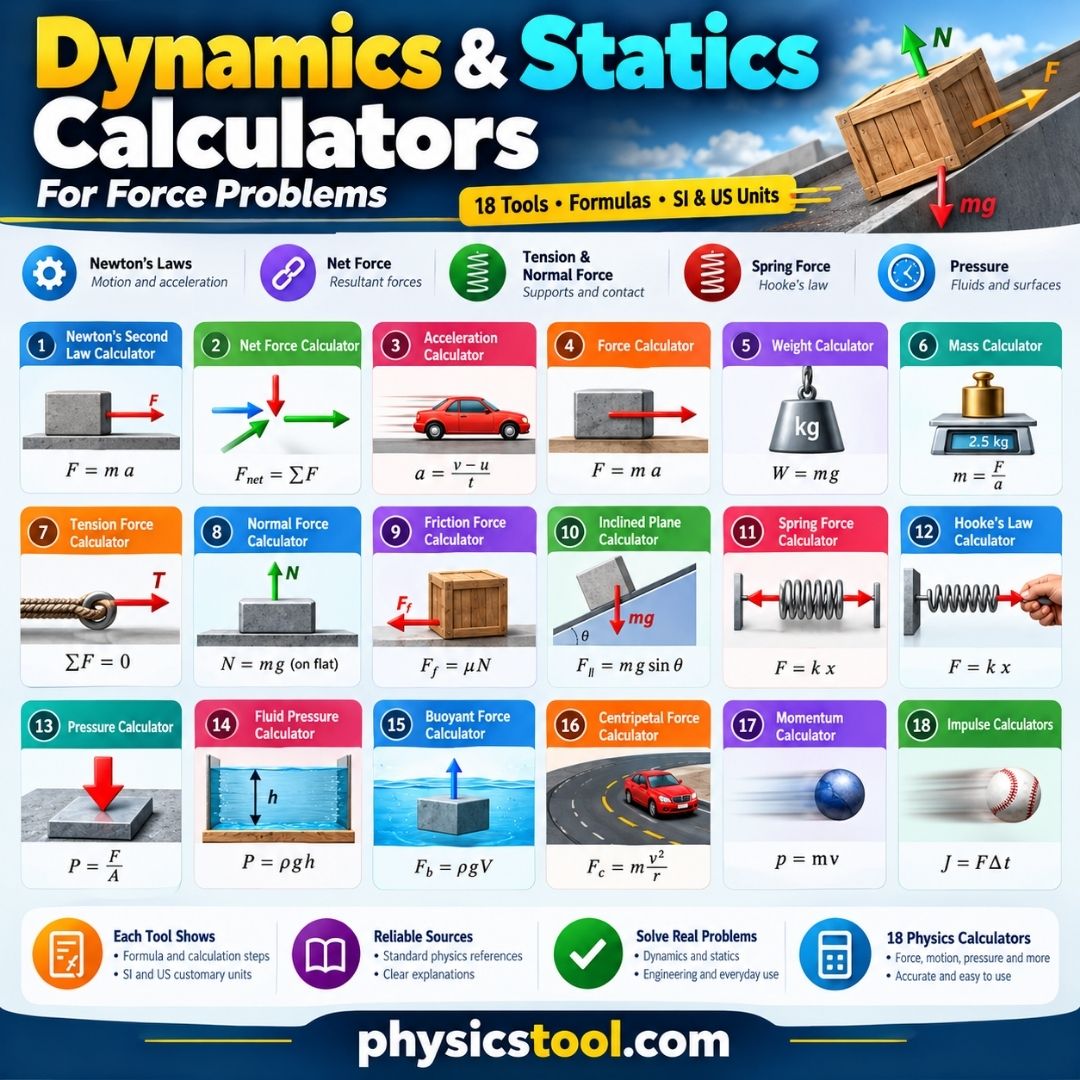
Dynamics and Statics Calculators
Dynamics and statics calculators for force problems. The 18 tools here cover Newton’s laws, net force, tension, normal force, spring force and pressure. Every answer comes with its formula and source, in SI and US customary units.
What you can calculate
- Force
- Net force
- Normal force
- Tension
- Newton’s laws
- Hooke’s law
- Pressure
- Weight
What Dynamics and Statics Calculators Solve
Both branches study forces, and one question separates them. Is the object accelerating? If the acceleration is zero, the problem is statics and the forces must balance. If it is not zero, the problem is dynamics and the leftover force sets the acceleration.
| Compare | Statics | Dynamics |
|---|---|---|
| Acceleration | Zero | Not zero |
| Governing equation | ΣF = 0 and Στ = 0 | ΣF = ma |
| Usual unknown | A support force, a tension or a reaction | An acceleration, or the force needed to cause one |
| Typical cases | A hanging sign, a book on a table, a parked car on a slope | A braking car, an elevator starting to rise, a car on a banked turn |
The two statics conditions are stated in OpenStax University Physics, section 12.1. The first says the forces sum to zero, so the object does not speed up in any direction. The second says the torques sum to zero, so it does not start to rotate.
The dynamics and statics calculators above stop at forces and acceleration. The motion that follows is a job for the kinematics calculators, which turn an acceleration into speed, distance and time.
Force Formulas at a Glance
Most dynamics and statics calculators in this hub rest on a short list of formulas. The Newton’s second law, weight, normal force, spring and tension rows match the key equations in OpenStax University Physics, chapter 5.
| Quantity | Formula | Applies when |
|---|---|---|
| Net force | Fnet = ma | Mass stays constant. |
| Weight | W = mg | The object is near a planet’s surface. |
| Normal force, level surface | N = mg | No other vertical force acts and the surface is not accelerating. |
| Normal force, incline | N = mg cos θ | The object rests or slides on a slope at angle θ. |
| Tension, hanging load | T = m(g + a) | The load accelerates upward at a. At rest, a = 0 and T = mg. |
| Spring force (Hooke’s law) | F = −kx | The spring stays within its elastic limit. |
| Pressure | P = F / A | The force acts at a right angle to the area. |
| Gravitational force | F = Gm1m2 / r2 | r is the distance between the centers of the two masses. |
| Banked turn, no friction | tan θ = v2 / (rg) | The car needs no friction to hold the curve at speed v. |
| Braking distance | d = v2 / (2μg) | Level road, wheels at the friction limit, reaction time not included. |
In the gravitational force row, G is 6.67430 × 10⁻¹¹ N·m2/kg2, the CODATA 2022 recommended value. It is the least precisely known of the major constants, so results from that formula are good to about five significant figures at best.
The braking row uses the friction coefficient μ between tire and road. At 27 m/s, about 60 mph, and μ = 0.7, the braking distance is 53.1 m, or 174 ft. The Friction Calculator covers where friction coefficients come from and how static and kinetic values differ.
Mass, Weight and Force Units
Mass and weight are different quantities. Mass is the amount of matter and is measured in kilograms. Weight is the force of gravity on that mass and is measured in newtons. A bathroom scale measures a force and then displays it as a mass.
That is why a kilogram cannot be converted to newtons without a value for g. At standard gravity, a mass of 1 kg weighs 9.80665 N, which is 2.2046 lbf. The conversion factors below come from NIST Special Publication 811.
| Unit | Equals | Type of quantity |
|---|---|---|
| 1 kilogram-force (kgf) | 9.80665 N | Force |
| 1 pound-force (lbf) | 4.448222 N | Force |
| 1 newton (N) | 0.224809 lbf | Force |
| 1 slug | 14.5939 kg | Mass |
| 1 pound per square inch (psi) | 6,894.757 Pa | Pressure |
| 1 standard atmosphere (atm) | 101,325 Pa, or 14.696 psi | Pressure |
One symbol causes regular confusion. An italic N in a formula is the normal force, while an upright N after a number is the newton. A line such as N = 100 N means the normal force is 100 newtons, a point OpenStax section 5.6 also flags.
Draw the Free-Body Diagram First
Dynamics and statics calculators only return the right answer when the right forces go in, and a free-body diagram is how you find them. It is a sketch of one object with every force on it drawn as an arrow. Four steps cover most problems.
- Pick one object and draw it alone, as a box or a dot.
- Add an arrow for each force that acts on it. Weight always points down. A surface adds a normal force at a right angle to itself, and friction along itself. A rope adds tension along the rope.
- Choose two axes. On a slope, tilt them so one axis runs along the slope.
- Add the forces along each axis. Set each sum to zero for statics, or to mass times acceleration for dynamics.
The same 10 kg crate gives three different answers depending on where it sits. The numbers below use g = 9.80665 m/s2, and they show why the supporting force is not always equal to the weight.
| Situation | Force found | Value |
|---|---|---|
| Resting on a level floor | Normal force, N = mg | 98.07 N |
| Resting on a 30° ramp | Normal force, N = mg cos θ | 84.93 N |
| Hanging from a cable that accelerates upward at 2 m/s2 | Tension, T = m(g + a) | 118.07 N |
On the ramp, the rest of the weight acts along the slope and tries to slide the crate downhill. The Inclined Plane Calculator works through that case with friction included.
Dynamics and Statics FAQ
Is an object moving at constant velocity in equilibrium?
Yes. Equilibrium means zero acceleration, not zero speed. Newton’s first law says velocity stays constant whenever the net force is zero, so a steadily moving object obeys the same equations as one at rest.
A car cruising at a steady 60 mph is an example. On a level road, the driving force at the wheels exactly equals air drag plus rolling resistance, and the net force is zero. The Rolling Resistance Calculator estimates one of those opposing forces.
Why is the normal force not always equal to weight?
The normal force is whatever the surface must supply to stop the object from sinking into it. It equals the weight only on a level surface with no other vertical force and no vertical acceleration.
Take a 70 kg person, who weighs 686.5 N. In an elevator accelerating upward at 1.5 m/s2, the floor pushes up with 70 × (9.80665 + 1.5) = 791.5 N. The person feels heavier, although the weight has not changed.
Do action and reaction forces cancel each other?
No, because they act on different objects. Newton’s third law pairs the force of A on B with the force of B on A. Only forces on the same object can be added together, so a third-law pair never appears in one free-body diagram.
A 2 kg book on a table shows the difference. Its weight of 19.6 N and the table’s normal force of 19.6 N both act on the book, and they balance. They are not a third-law pair. The partner of the book’s weight is the book’s pull on the Earth.
What is the difference between net force and applied force?
The applied force is one push or pull. The net force is the vector sum of every force on the object, and it is the only one that sets the acceleration. Dynamics and statics calculators that ask for a net force expect that sum.
Suppose you push a 10 kg box with 50 N while friction pushes back with 20 N. The net force is 30 N, so the box accelerates at 30 / 10 = 3 m/s2. Using the 50 N push alone would give 5 m/s2, which is wrong.