
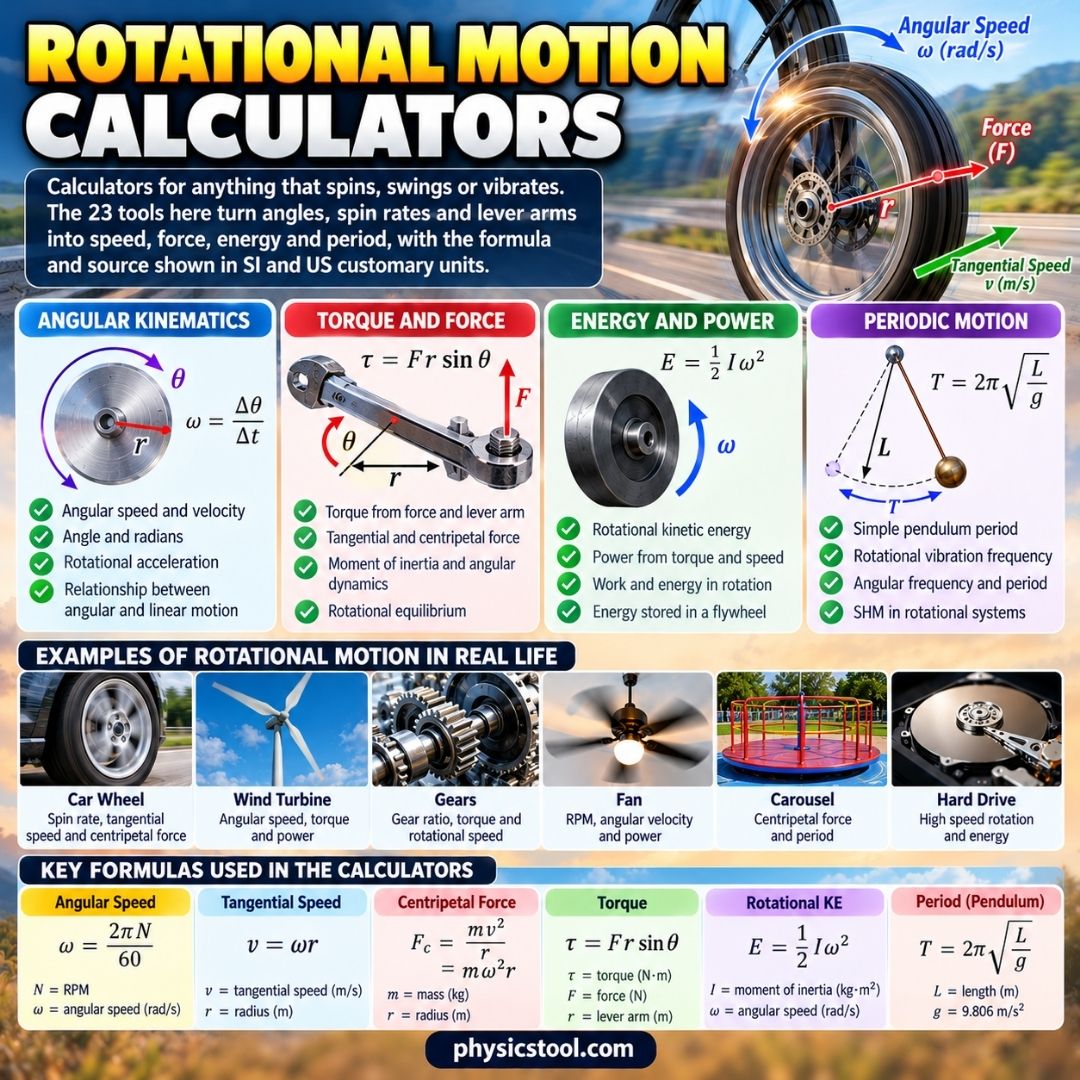
Rotational Motion Calculators
Rotational motion calculators for anything that spins, swings or vibrates. The 23 tools here turn angles, spin rates and lever arms into speed, force, energy and period, with the formula and source shown in SI and US customary units.
What you can calculate
- Angular velocity
- Torque
- Moment of inertia
- Angular momentum
- Centripetal force
- Pendulum
- Harmonic motion
- Frequency
Rotational Motion Calculators and Their Linear Twins
Every straight-line quantity has a rotating partner. Distance becomes angle, mass becomes moment of inertia and force becomes torque. Once you see the pairs, the rotational motion calculators above use the same logic as the kinematics calculators, with new symbols.
| Linear quantity | Rotational partner | Link between them |
|---|---|---|
| Displacement, s (m) | Angle, θ (rad) | s = rθ |
| Velocity, v (m/s) | Angular velocity, ω (rad/s) | v = rω |
| Acceleration, a (m/s2) | Angular acceleration, α (rad/s2) | at = rα |
| Mass, m (kg) | Moment of inertia, I (kg·m2) | I = Σmr2 |
| Force, F (N) | Torque, τ (N·m) | τ = rF sin θ |
| F = ma | τ = Iα | Newton’s second law for rotation |
| Momentum, p = mv | Angular momentum, L = Iω | Both are conserved when no outside push acts |
| Kinetic energy, ½mv2 | Rotational kinetic energy, ½Iω2 | Both in joules |
The rotational rows follow the key equations in OpenStax University Physics, chapter 10. The constant-acceleration rules carry over as well. For example, ω = ω0 + αt has the same shape as v = u + at.
The links in the third column only work with angles in radians. That single rule explains most wrong answers in rotation problems. If you enter rpm or degrees into rotational motion calculators that ask for rad/s, convert first.
Radians, RPM and Hertz
One full turn is 2π radians, which is 360°. Machines quote speed in revolutions per minute, physics formulas want radians per second, and waves use hertz, which counts full cycles per second. The conversions are short once the 2π is in place.
| From | To | Multiply by |
|---|---|---|
| rpm | rad/s | 2π / 60 = 0.10472 |
| rad/s | rpm | 60 / 2π = 9.5493 |
| Hz (rev/s) | rad/s | 2π = 6.2832 |
| degrees | radians | π / 180 = 0.017453 |
| lbf·ft (torque) | N·m | 1.355818 |
A motor at 3,000 rpm turns at 3,000 × 0.10472 = 314.16 rad/s, which is 50 Hz. Angular frequency ω and plain frequency f differ by that same factor, ω = 2πf, and mixing them up gives answers off by 6.28. The torque factor comes from NIST Special Publication 811.
Moment of Inertia for Common Shapes
Several rotational motion calculators ask for a moment of inertia, and the table below supplies it for common shapes. Moment of inertia measures how hard an object is to spin up. It depends on where the mass sits, not only on how much there is. Mass far from the axis counts for more, because each piece adds m times r2.
| Shape and axis | Moment of inertia |
|---|---|
| Point mass at distance r | mr2 |
| Thin hoop or ring, about its center | mr2 |
| Solid disk or cylinder, about its center | ½mr2 |
| Solid sphere, about its center | ⅖mr2 |
| Thin spherical shell, about its center | ⅔mr2 |
| Thin rod of length L, about its center | 1/12 mL2 |
| Thin rod of length L, about one end | ⅓mL2 |
Shape decides who wins a race down a ramp. Released from 1 m high and rolling without slipping, a solid sphere reaches 3.74 m/s, a solid disk 3.62 m/s and a thin hoop only 3.13 m/s. The hoop keeps more of its energy in spinning, so less is left for forward speed.
This mass moment of inertia is not the same as the polar moment of inertia used for shafts. The polar value describes the shape of a cross-section, in m4 or in4, and it sets how much a shaft resists twisting. The Polar Moment of Inertia Calculator covers that one.
Circular Motion and Oscillation Formulas
Several rotational motion calculators deal with paths that curve or repeat rather than with spinning objects. The pendulum and harmonic motion rows below follow chapter 15 of the same OpenStax book, and OpenStax section 15.4 derives the pendulum periods.
| Quantity | Formula | Notes |
|---|---|---|
| Centripetal acceleration | ac = v2 / r = ω2r | Points toward the center of the circle. |
| Centripetal force | Fc = mv2 / r | Supplied by friction, tension, gravity or a normal force. |
| Relative centrifugal force | RCF = 1.118 × 10⁻⁵ × r × rpm2 | r in cm. The result is in multiples of g. |
| Simple pendulum period | T = 2π√(L / g) | Small swings, below about 15°. |
| Physical pendulum period | T = 2π√(I / mgd) | d is the distance from the pivot to the center of mass. |
| Mass on a spring | ω = √(k / m) | The period is T = 2π / ω. |
| Damping ratio | ζ = c / (2√(km)) | ζ < 1 rings down, ζ = 1 is critical, ζ > 1 creeps back. |
| Flywheel energy | E = ½Iω2 | ω in rad/s gives joules. |
| Wave speed | v = fλ | Wavelength λ times frequency f. |
A 1 m pendulum swings with a period of 2π√(1 / 9.80665) = 2.006 s. A pendulum with a period of exactly 2 s is 0.994 m long, which is why old clocks used pendulums close to one meter.
The RCF row converts a lab centrifuge setting into g-force. A rotor radius of 10 cm at 10,000 rpm gives 1.118 × 10−5 × 10 × 10,0002 = 11,180 × g. The spring constant k in the spring rows is the one the Hooke’s Law Calculator finds from force and stretch.
Questions on Spinning and Swinging
What is the difference between centripetal and centrifugal force?
Centripetal force is the real inward pull that keeps an object on a curve. Centrifugal force is the outward push you seem to feel, and it exists only from inside the rotating frame. Both have the same size, mv2 / r.
A 1,200 kg car taking a 50 m curve at 20 m/s needs 1,200 × 202 / 50 = 9,600 N of centripetal force. On a flat road the tires supply all of it through friction. On a banked road the tilt supplies part of it, as the Angle of Banking Calculator shows.
Why doesn’t a pendulum’s period depend on its mass?
Gravity pulls harder on a heavier bob, but the heavier bob is also harder to accelerate. The two effects cancel exactly, which is why a simple pendulum’s period needs no mass at all. Only length and gravity remain in T = 2π√(L / g). A steel bob and a wooden bob on the same string keep the same time.
The swing angle does matter a little. The simple formula assumes small swings. At a 30° amplitude the true period is about 1.7% longer, and the error grows quickly past that, which is why accurate pendulum clocks swing through small arcs.
Why does a spinning skater speed up when she pulls her arms in?
Angular momentum L = Iω stays constant when no outside torque acts. Pulling the arms in moves mass closer to the axis and lowers the moment of inertia. If I drops to half, ω must double to keep L the same.
Her kinetic energy, ½Iω2, doubles at the same time. That extra energy comes from the work her arm muscles do pulling inward. It is the rotating version of linear momentum conservation, which the Momentum Calculator handles for straight-line motion.
Does a flywheel store more energy if it spins faster or weighs more?
Speed wins. Energy rises with the square of angular velocity but only in proportion to mass. Doubling the mass doubles the stored energy, while doubling the speed multiplies it by four, which is why modern flywheels spin very fast.
A 100 kg solid disk with a 0.5 m radius has I = ½ × 100 × 0.52 = 12.5 kg·m2. At 3,000 rpm, or 314.16 rad/s, it stores ½ × 12.5 × 314.162 = 616,850 J, about 0.17 kWh. Compare that with the straight-line energies in the energy, work and power calculators.