
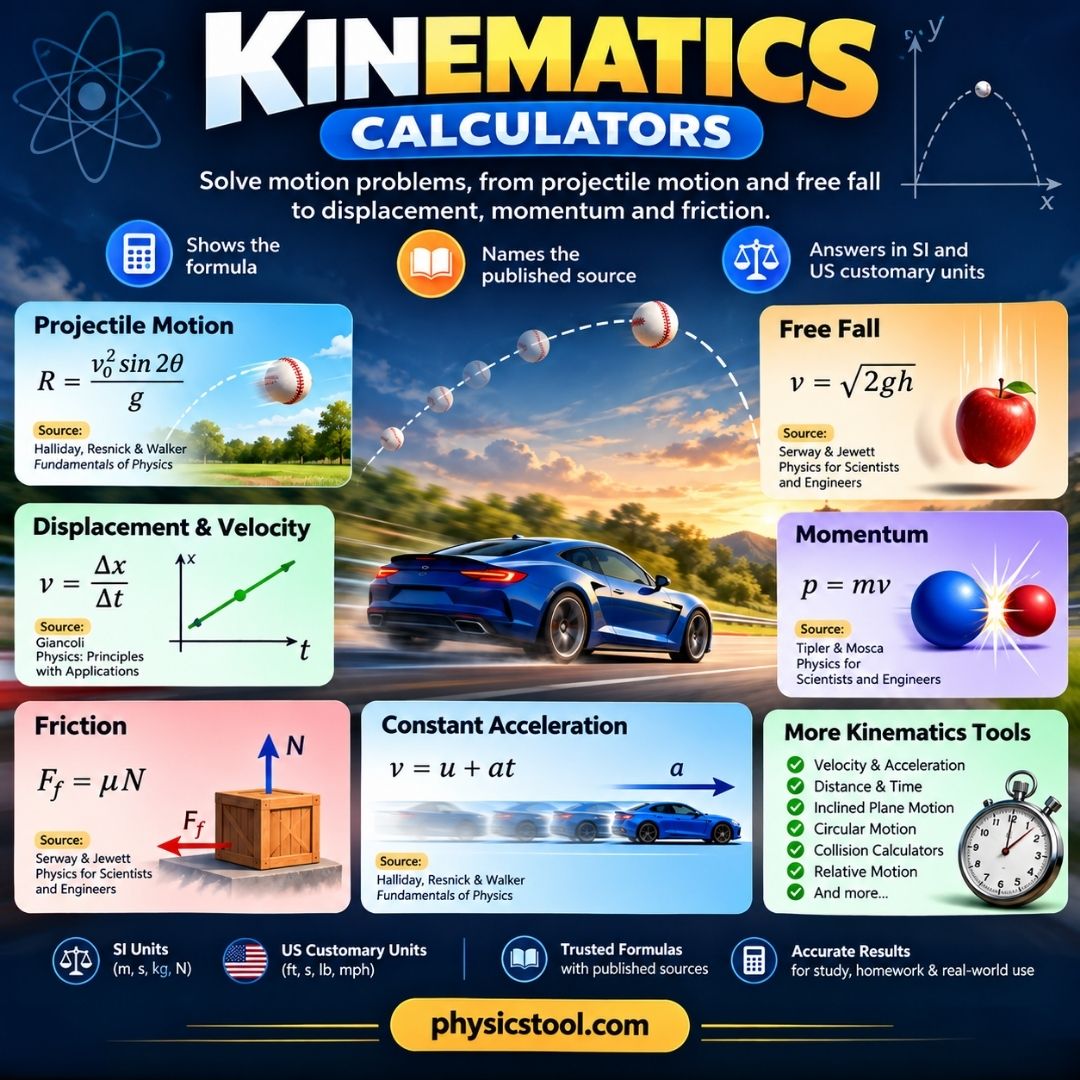
Kinematics Calculators
These 29 kinematics calculators solve motion problems, from projectile motion and free fall to displacement, momentum and friction. Each one shows its formula, names the published source, and gives answers in SI and US customary units.
What you can calculate
- Projectile motion
- Free fall
- Displacement
- Velocity
- Acceleration
- Momentum
- Friction
- Inclined plane
What the Kinematics Calculators Cover
Kinematics describes motion through position, velocity, acceleration and time, without asking what causes it. The kinematics calculators in this hub are grouped by the kind of problem they solve, so you can match your question to a group first.
| Problem type | What you can solve |
|---|---|
| Straight-line motion | Velocity, displacement, acceleration and time under constant acceleration, plus two velocities added as vectors. |
| Falling objects | Fall time, drop height and impact speed, with or without air resistance, and terminal velocity. |
| Projectile motion | Range, maximum height, time of flight and the full path, for angled and horizontal launches. |
| Momentum and collisions | Momentum, impulse, and the velocities of two objects after they collide. |
| Friction and slopes | Friction force, rolling resistance, and motion down an inclined plane. |
| Ballistics and archery | Muzzle velocity, ballistic coefficient, minute of angle and arrow speed. |
| Vehicles | Quarter-mile time and the distance a car covers off a ramp. |
The Four Kinematic Equations
The straight-line, free fall and projectile kinematics calculators all run on the same four equations. They link five quantities, and each equation leaves exactly one of them out. The versions below follow OpenStax University Physics, section 3.4.
| Equation | Leaves out | Reach for it when |
|---|---|---|
| v = u + at | Displacement, s | The problem gives a time and never mentions distance. |
| s = ut + ½at2 | Final velocity, v | You know how the motion starts and how long it lasts. |
| v2 = u2 + 2as | Time, t | No time is given and none is asked for. |
| s = ½(u + v)t | Acceleration, a | Both velocities are known but the acceleration is not. |
Here s is displacement, u is initial velocity, v is final velocity, a is acceleration and t is time. US textbooks often write the same equations with Δx for displacement and v0 for initial velocity. The physics is identical, and only the letters change.
To pick an equation, mark the three quantities you know and the one you want. The fifth quantity is the one the problem never mentions, so use the equation that leaves it out. All four assume the acceleration stays constant for the whole interval.
Clues Hidden in the Wording
Many problems seem to give only two numbers, and the third is hidden in a phrase. Check for these phrases before you enter numbers into any of the kinematics calculators.
| The problem says | It means |
|---|---|
| Starts from rest | u = 0 |
| Comes to a stop | v = 0 |
| Is dropped or released | u = 0, and a = g pointing down |
| Reaches its highest point | Vertical velocity = 0 at that instant |
| Moves at constant speed in a straight line | a = 0 |
| Is thrown horizontally | Initial vertical velocity = 0 |
| Lands at the height it was launched from | Vertical displacement = 0 |
Projectile Motion Formulas
A projectile keeps a constant horizontal velocity while its vertical velocity changes at the rate g. For a launch speed v0 at an angle θ above the horizontal, three results follow from OpenStax University Physics, section 4.3.
Time of flight: T = 2v0 sin θ / g
Range: R = v02 sin 2θ / g
Maximum height: H = v02 sin2 θ / (2g)
A ball launched at 20 m/s and 30° stays in the air for 2.04 s, lands 35.3 m away and peaks at 5.10 m. The time of flight and range formulas only hold when the projectile lands at its launch height, and all three ignore air resistance.
Which Value of g to Use
The kinematics calculators here use standard gravity, g = 9.80665 m/s2, which equals 32.174 ft/s2. NIST lists this value as exact, because it is a defined standard and not a measurement.
Many textbooks round g to 9.8 or 9.81 m/s2, which differ from the standard by 0.07% and 0.03%. If your answer and the book answer disagree in the third or fourth digit, the rounding of g is the usual reason.
Kinematics FAQ
Do the kinematic equations work when acceleration changes?
No. All four equations assume one constant acceleration, and the kinematics calculators built on them share that limit. If the acceleration changes in steps, split the motion into stages. The final velocity of one stage becomes the initial velocity of the next.
If the acceleration changes smoothly, the equations fail and calculus takes over. A falling object with air drag is the common case, because drag grows as speed grows. That is why free fall with air resistance is handled separately from plain free fall.
Why is my velocity or displacement negative?
A negative sign shows direction, not an error. You choose which direction is positive, and every quantity in the problem must follow that choice. With up as positive, gravity enters as a = −9.80665 m/s2.
Take a ball thrown upward at 15 m/s. After 2 s its velocity is 15 − 9.80665 × 2 = −4.61 m/s. The ball has passed its peak and is moving down at 4.61 m/s. A negative displacement means it is below the starting point.
Does a heavier object fall faster?
Without air resistance, no. Mass cancels out of the free fall equations. Any object dropped from 20 m lands after 2.02 s at 19.8 m/s, whether it weighs one gram or one ton.
In real air the answer changes. Drag depends on shape and size, while weight depends on mass. A heavier object of the same shape has a higher terminal velocity, so it does fall faster over a long drop.