
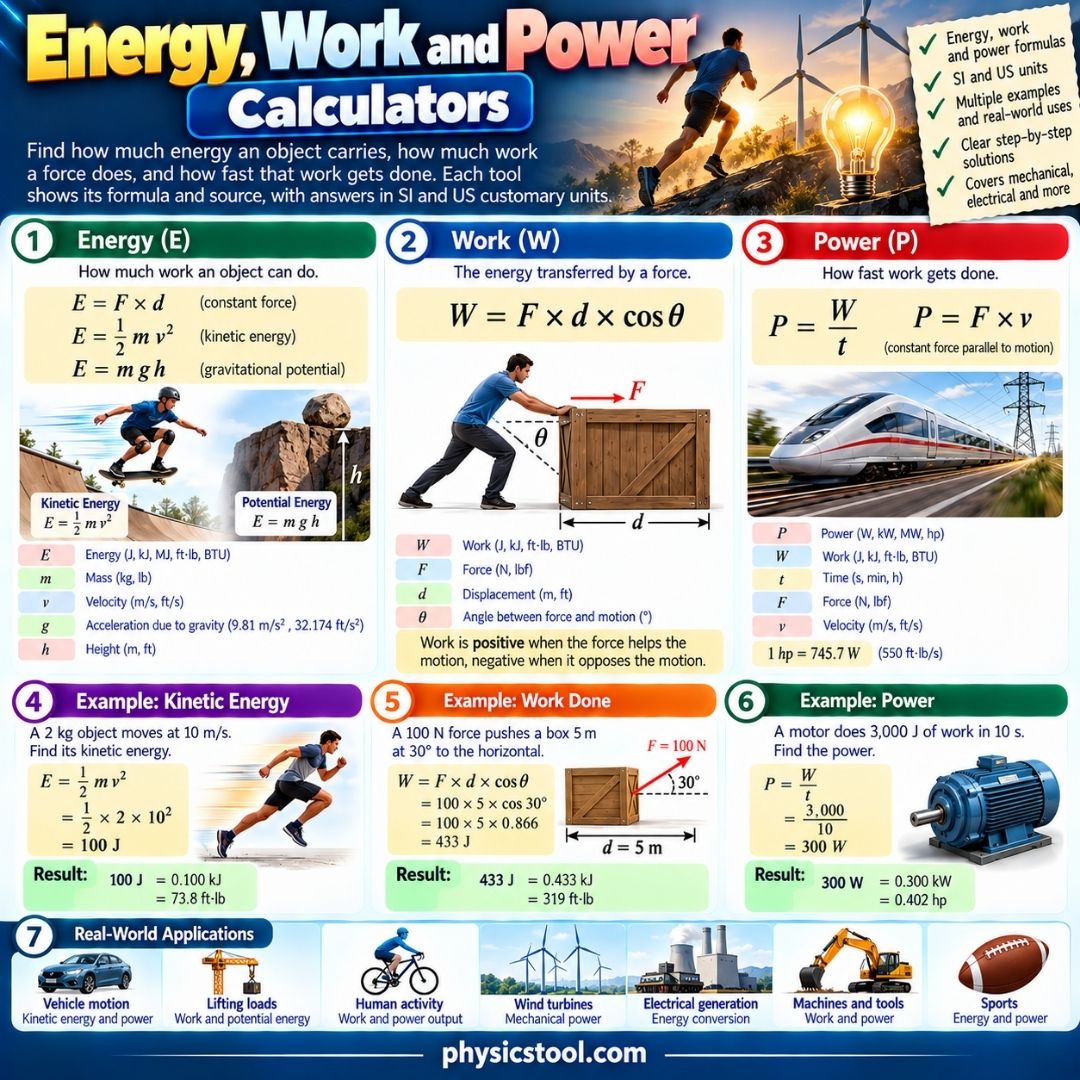
Energy, Work and Power Calculators
These 15 energy, work and power calculators find how much energy an object carries, how much work a force does, and how fast that work gets done. Each tool shows its formula and source, with answers in SI and US customary units.
What you can calculate
- Kinetic energy
- Potential energy
- Work
- Power
- Elastic energy
- Impact energy
- Bullet energy
- TNT equivalent
How Energy, Work and Power Calculators Connect
Energy, work and power are three views of one idea. Energy is what an object has. Work is energy moved from one object to another by a force. Power is how fast that transfer happens. Mixing them up is the most common reason an answer comes out in the wrong unit.
| Quantity | What it answers | SI unit | Everyday example |
|---|---|---|---|
| Energy | How much can this object do? | joule (J) | A 1,500 kg car at 27 m/s carries 546,750 J. |
| Work | How much energy did this force transfer? | joule (J) | The brakes remove those 546,750 J to stop the car. |
| Power | How fast was the energy transferred? | watt (W), or J/s | An engine that supplies that energy in 8 s averages 68,344 W. |
Energy and work share the joule because work is simply energy in transit. Power always has a time in it. If a question asks “how much”, it wants energy or work. If it asks “how quickly” or gives a rating in watts or horsepower, it wants power.
The energy, work and power calculators above each handle one of these questions. Forces come first in many problems, and the dynamics and statics calculators cover that step before the energy is worked out.
Energy, Work and Power Formulas
Every one of the energy, work and power calculators here reduces to a short formula. The mechanical rows in this table follow the key equations in OpenStax University Physics, chapter 7 for work, kinetic energy and power, and chapter 8 for potential energy. The last four rows are the trade formulas behind the ballistics, blast and radio tools in this hub.
| Quantity | Formula | Notes |
|---|---|---|
| Work by a constant force | W = Fd cos θ | θ is the angle between the force and the motion. |
| Kinetic energy | KE = ½mv2 | Valid well below the speed of light. |
| Gravitational potential energy | PE = mgh | Near a planet’s surface, with h measured from a chosen zero level. |
| Elastic potential energy | U = ½kx2 | For a spring that obeys Hooke’s law. |
| Work-energy theorem | Wnet = ΔKE | Net work equals the change in kinetic energy. |
| Average power | P = W / t | Work done divided by the time taken. |
| Power from force and speed | P = Fv | Force and velocity along the same line. |
| Power-to-weight ratio | PWR = P / m | Usually quoted in W/kg or hp/lb. |
| Bullet or arrow energy | E = wv2 / 450,437 | w in grains, v in ft/s, E in ft·lbf. |
| TNT equivalent | mTNT = E / (4.184 × 10⁹ J) | Result in tons of TNT. |
| EIRP | EIRP = Pt − L + G | Transmit power in dBm, cable loss in dB, antenna gain in dBi. |
| Signal-to-noise ratio | SNR = 10 log10(Ps / Pn) | Result in dB, from two powers in the same unit. |
The bullet energy divisor is not a mystery number. It is 2 × 32.174 × 7,000, which folds in standard gravity in ft/s2 and the 7,000 grains in a pound. A 150 grain bullet at 2,800 ft/s carries 150 × 2,8002 / 450,437 = 2,611 ft·lbf, or 3,540 J.
Speed for that formula has to be measured or estimated first. The Muzzle Velocity Calculator gives a muzzle speed estimate, and the result drops straight into the energy formula above.
Solving Motion With Energy
Energy methods skip the time variable, which makes some problems much shorter. The work-energy theorem links a force and a distance directly to a change in speed. A 1,500 kg car at 27 m/s has 546,750 J of kinetic energy, and the brakes must do that much negative work to stop it.
With a tire grip of μ = 0.7, the braking force is 0.7 × 1,500 × 9.80665 = 10,297 N. Dividing the energy by the force gives 546,750 / 10,297 = 53.1 m, about 174 ft. The Stopping Distance Calculator is built for that road problem.
Conservation of energy works the same way for a fall. Potential energy at the top becomes kinetic energy at the bottom, so mgh = ½mv2 and the mass cancels. An object dropped from 10 m lands at √(2 × 9.80665 × 10) = 14.0 m/s, the same speed the Free Fall Calculator returns.
A spring stores energy by the same bookkeeping. A spring with k = 200 N/m compressed by 0.1 m holds ½ × 200 × 0.12 = 1 J. The spring constant itself comes from force and stretch, which the Hooke’s Law Calculator finds.
Joules, Foot-Pounds, Watts and Horsepower
Energy, work and power calculators usually report more than one unit, because physics classes use joules and watts while US trades use foot-pounds and horsepower. The factors below come from NIST Special Publication 811. The kilowatt-hour, calorie and ton of TNT values are exact by definition.
| Unit | Equals | Type of quantity |
|---|---|---|
| 1 foot-pound force (ft·lbf) | 1.355818 J | Energy |
| 1 kilowatt-hour (kWh) | 3,600,000 J | Energy |
| 1 thermochemical calorie (cal) | 4.184 J | Energy |
| 1 food Calorie (kcal) | 4,184 J | Energy |
| 1 ton of TNT | 4.184 × 10⁹ J | Energy |
| 1 watt (W) | 1 J/s | Power |
| 1 mechanical horsepower (hp) | 550 ft·lbf/s, or 745.70 W | Power |
Decibel units describe power as a ratio, which is why radio tools sit among these energy, work and power calculators. A level in dBm is 10 log10 of the power in milliwatts, so 0 dBm is 1 mW and 30 dBm is 1 W. Adding 10 dB multiplies the power by 10, and adding 3 dB roughly doubles it.
A transmitter at 20 dBm feeding a 16 dBi antenna through a lossless cable has an EIRP of 36 dBm. Converting back, 103.6 mW is 3.98 W. The antenna has not created power. It has concentrated the same 100 mW into a narrower beam.
Common Energy and Power Questions
Is holding a heavy object work?
Not in the physics sense. Work needs a force and a displacement along that force, so W = Fd cos θ is zero when nothing moves. Your muscles still burn energy to stay tense, which is why your arms tire, but no energy is transferred to the object.
Lifting a 20 kg box by 1.5 m does 20 × 9.80665 × 1.5 = 294 J of work on it. Holding it there does 0 J. Carrying it across a level room at steady speed also does 0 J on the box, because the lifting force is at 90° to the motion.
What is the difference between kW and kWh?
A kilowatt is power, a rate of 1,000 joules every second. A kilowatt-hour is energy, the amount delivered by 1 kW running for one hour. That equals 1,000 × 3,600 = 3,600,000 J, or 3.6 MJ.
A 1,000 W heater running for 3 hours uses 3 kWh, which is 10.8 MJ. The car in the table above, at 546,750 J, carries only 0.15 kWh of kinetic energy. Motion energy is small next to the energy in fuel or a battery.
Why does doubling speed quadruple kinetic energy?
Kinetic energy depends on the square of speed. For the same 1,500 kg car, the energy is 136,688 J at 13.5 m/s, 546,750 J at 27 m/s and 2,187,000 J at 54 m/s. Each doubling of speed multiplies the energy by four.
Braking distance follows the same rule, because the brakes remove energy at a roughly fixed force. A car that stops in 53 m from 27 m/s needs about 212 m from 54 m/s. Crash energy rises the same way, and the Car Crash Calculator covers the forces that result.
Can work or kinetic energy be negative?
Work can be negative. Kinetic energy cannot. Work is negative when the force points against the motion, as friction and braking forces do, and it means energy is leaving the object. The brakes in the earlier example do −546,750 J of work on the car.
Kinetic energy is ½mv2, and both mass and the square of speed are positive. Potential energy is different again. It can be negative, because its zero level is a free choice, and only changes in potential energy affect the motion.
Are foot-pounds of energy the same as pound-feet of torque?
No, although both multiply a force in pounds by a length in feet. Energy in ft·lbf is a force acting along a distance the object moves. Torque in lb·ft is a force acting at a right angle to a lever arm, with no motion required.
The two meet only when something rotates. Torque times the angle turned, in radians, gives work. One full turn at 100 lb·ft is 100 × 2π = 628 ft·lbf of work, which is 852 J. That link is also how an engine’s torque and its horsepower are related.